CHANGING THE WAY WOMEN AGE.


How to Build Muscle While You Sleep
Listen, if you hit a wall in your journey to build muscle, it’s probably because you’re cutting off too many carbs, doing really long but easy workouts, or lacking quality sleep.
Although diet and exercise always make it to the headlines when it comes to fitness, there’s still so much we don’t know about how we should do them. And sleep is often overlooked.
In reality, carbohydrates help fuel performance, long low-intensity workouts aren’t always the most effective way to build lean muscle, and recovery, including quality sleep, is just as important as exercise.
After 40, natural changes in hormones and muscle metabolism can make it harder to maintain or build muscle, which can sometimes make progress feel slower than it once did.
So, taking a nutritional supplement designed to support muscle health and recovery can be a helpful addition to your routine as you work toward your fitness goals.
Let’s look at three key factors that support muscle health—and the nutritional support that can help you get more out of them.
3 Factors to Focus on to Build Muscle While You Sleep

1. Exercise
We’re not talking about easy-peasy, I-can-do-this-all-day exercises, though. Instead, you need to wear down your muscles for them to grow and become stronger.
Muscles grow stronger when they are challenged through resistance or strength training, forcing them to repair themselves and adapt to handle the stimulus better next time. That’s why the key to building muscle is intensity, not duration.
Drop your 45-minute cardio and switch to weight lifting, resistance training, and bodyweight training. These strength exercises promote muscle growth as long as you increase the intensity once a workout becomes too easy for you.
The rule of thumb is that the weight or resistance should be significant enough that you can only do 12-15 repetitions before your muscles become exhausted.
For instance, if you’re doing bodyweight training and can easily do two sets of 20 squats, try adding some weight by strapping a resistance band from your feet and pull up or holding 10-pound (or heavier, depending on what’s really challenging for you) dumbbells in each hand as you’re squatting.
You know the resistance is appropriate if the last few repetitions feel challenging while still allowing you to maintain good form.
Over time, your muscles get stronger, and you’ll need to add more weight to keep the intensity up there.
2. Diet
After getting torn and worn out by exercise, your muscles need to repair themselves and recover. For that, you need a proper diet and sleep. Let’s talk about diet first.
Your body needs all macronutrients— protein, fat, and carbohydrates— to support muscle recovery and maximize muscle building.
Protein
You can never go wrong with high-protein foods in increasing muscle mass and strength. Proteins are made of amino acids, molecules that help repair and preserve muscle.
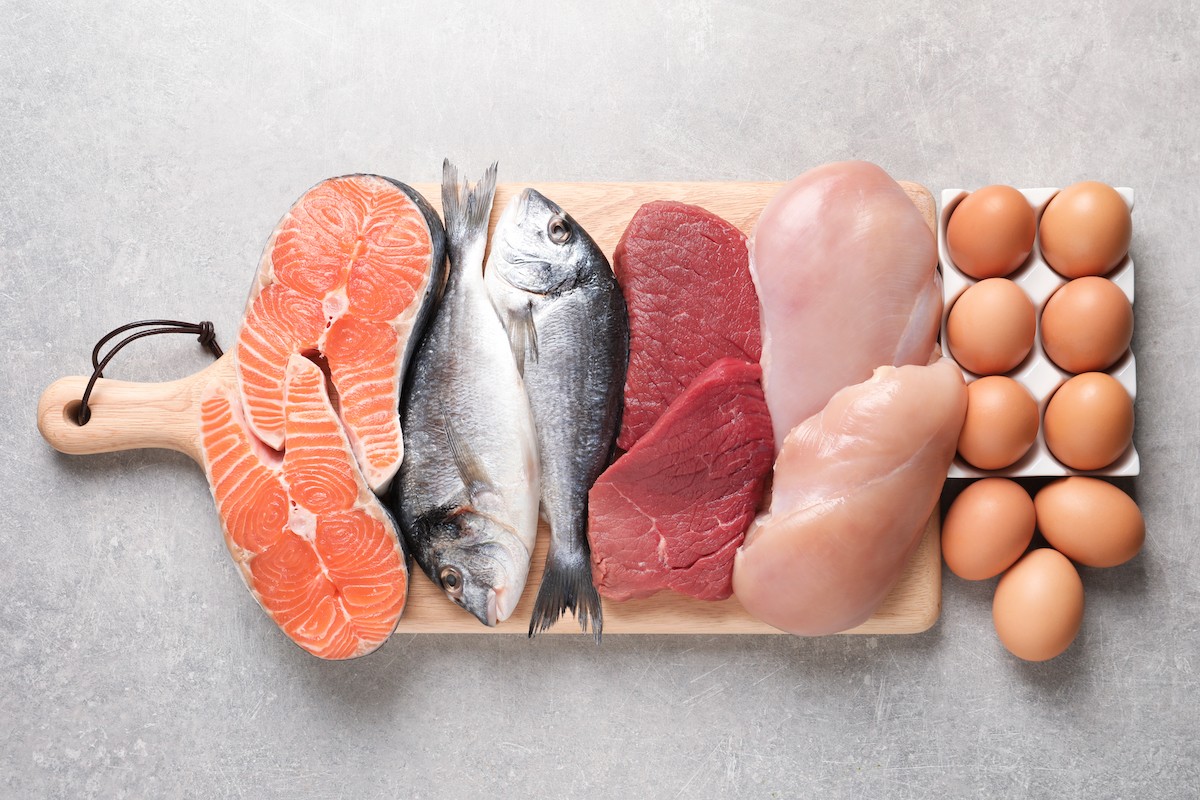
Eating foods that boost collagen production is also helpful. Collagen is the most abundant protein in the body and plays an important role in connective tissues that support muscles, joints, and skin. Not to mention it keeps your skin younger-looking.
Eggs, fish (such as tuna and salmon), and lean meat are some of the best protein sources.
-
Eggs are high in protein and choline, a micronutrient that significantly contributes to muscle function and growth. In fact, choline improves performance and stamina during exercise. Eggs are also rich in proline, vitamin D, and biotin, which are necessary for collagen production.
-
Fishes are packed with protein. Just 100 grams of salmon contain 22 grams of protein, while 100 grams of tuna has 28 grams.
-
Lean meats such as chicken and beef are also excellent sources of protein. A 100-gram serving of chicken breast contains 31 grams of protein, while 100 grams of chicken liver has 16.9 grams of protein.
In addition, 100 grams of beef with 85% lean meat has 26 grams of protein.
Other protein-rich foods are Greek yogurt, soybeans, and cottage cheese.
Fat
Healthy fats increase the levels of good cholesterol, which stimulate the production of growth hormones. These growth hormones help the body produce amino acids, the building blocks of protein.
Omega-3 fatty acids are especially beneficial in building muscle and improving our health. Aside from promoting muscle growth by increasing protein synthesis, omega-3 also lowers blood pressure and helps build nerve cells to enhance learning and memory.
Foods rich in omega-3 fatty acids and other healthy fats are eggs, fatty fish (e.g., tuna, salmon, mackerel, herring, and anchovy), avocado, nuts, chia seeds, and dark chocolate.

Carbohydrates
Carbohydrates are stereotyped so much that they often get cut off when talking about health and fitness. But carbs are not an enemy. In fact, they support muscle building.
By providing the body with much-needed energy, carbohydrates save muscle tissue from being broken down by our body for energy.
However, you should eat the right kind of carbohydrate. There are two: simple carbohydrates (unhealthy) and complex carbohydrates (healthy).
Simple carbohydrates are the unhealthy kind that gives you energy spikes. But this energy doesn’t last. Before long, your energy crashes, and you’ll feel tired again.
Some examples of simple carbohydrates are candies, baked goods, ice cream, and sugary drinks.
On the other hand, complex carbohydrates digest slowly, giving you better, steadier energy that lasts longer. Because of this, they’re an excellent fuel that keeps your body from breaking down muscle tissue to function properly.
Examples of healthy, complex carbohydrates are oats, whole grains, quinoa, beans, potatoes, peas, fruits, and vegetables.
Nutritional supplement with HMB
We can only eat so much to meet our body’s daily protein and other nutrients to build muscle. Plus, it’s challenging to build muscle once you’re past 40 after all the collagen and muscle you’ve lost (and are still losing since you turned 30).
So, adding a nutritional supplement that helps boost the benefits of exercise and diet is extremely helpful.
Try taking the life-changing, age-reversing AgelessLX Nutritional Supplements. AgelessLX contains HMB (beta hydroxy beta methylbuterate). HMB is studied for its role in supporting muscle protein synthesis and helping reduce muscle breakdown.
Research proves that HMB can help support muscle retention during calorie-restricted diets. It also improves your muscle’s efficiency in metabolizing fat for weight loss and increased energy.

AgelessLX also has biotin, Vitamin D3, and Vitamin K2. These nutrients help your body produce more collagen, the protein that keeps your muscles strong and your skin tight, smooth, and elastic.
To sum up, AgelessLX helps you build muscle, promotes fat loss, increases your energy, and brings back your supple, radiant, younger-looking skin!
Thousands of women have testified how AgelessLX is helping them gain muscle definition, have more energy, and restore youthful skin. Many women report feeling stronger, more energized, and more confident as they support their health routines.
3. Deep Sleep
Sleep is when your body takes its sweet time to repair torn muscles using the nutrients it absorbed from the foods and supplements you take in.
However, sleeping 7 to 9 hours of sleep is only part of the equation, because sleep quality also plays an important role in recovery. You should sink into deep sleep, the 3rd stage of the 4-stage sleep cycle, to benefit from sleep’s restorative benefits.
Deep sleep is when your body supplies more blood to your muscles to feed them with much-needed nutrients, repair damaged cells and regenerate new ones, grow tissues and muscles, and restore energy.

Without it, your body won’t recover, the inflammation will persist, and you’ll be in too much pain to workout or even do chores for the next couple of days.
Therefore, you should develop better sleep hygiene to get deep, restful, rejuvenating sleep. Here are some tips:
-
Don’t drink alcohol three (3) hours before bedtime. Alcohol inhibits the production of melatonin, the sleep hormone.
-
Don’t drink coffee and other caffeinated drinks six (6) hours before bedtime. Research proves that caffeine disrupts sleep. Drink tea or water before going to sleep instead.
-
Take a hot shower and pee first before going to bed.
-
Make sure your room is dim and cold, and your feet are toasty.
-
End screen time 30 minutes before you sleep. The light from your screen also inhibits melatonin production.
Supporting overall nutrition may also contribute to better rest and recovery. Around 96% of satisfied users reported they started sleeping better after taking AgelessLX for just two weeks!
Try it today and start living ageless!
Takeaway
Exercise, diet, and sleep are essential in preserving and building muscle mass— your progress will stall if any of these are missing.
When you exercise, focus on intensity. In terms of diet, you should eat protein, fat, and carbs. And when you sleep, make sure you not only sleep 7 to 9 hours at night but also fall into deep sleep.
However, building muscle can be difficult if you’re over 40. So, taking a nutritional supplement with HMB, such as AgelessLX, can complement a healthy routine that includes exercise, balanced nutrition, and good sleep habits.
CONTEXTUAL LINKS:
-
Biochemistry, Collagen Synthesis - StatPearls - NCBI Bookshelf (nih.gov)
-
Proline Precursors and Collagen Synthesis: Biochemical Challenges of Nutrient Supplementation and Wound Healing - PMC (nih.gov)
-
Egg, whole, raw, fresh Nutrition Facts & Calories (self.com)
-
Choline: An Essential Nutrient for Skeletal Muscle - PMC (nih.gov)
-
FINAL sports backgrouinder.docx (live.com)
-
Chicken Liver: Nutrition Facts and Top 10 Benefits - Dr. Robert Kiltz (doctorkiltz.com)
-
Yogurt, vanilla, low fat, 11 grams protein per 8 ounce Nutrition Facts & Calories (self.com)
-
Soybeans, mature cooked, boiled, without salt Nutrition Facts & Calories (self.com)
-
Cheese, cottage, lowfat, 1% milkfat Nutrition Facts & Calories (self.com)
-
The Influence of Omega-3 Fatty Acids on Skeletal Muscle Protein Turnover in Health, Disuse, and Disease - PMC (nih.gov)
-
HMB attenuates muscle loss during sustained energy deficit induced by calorie restriction and endurance exercise - PubMed (nih.gov)
-
Effect of β-hydroxy-β-methylbutyrate Supplementation During Energy Restriction in Female Judo Athletes | Request PDF (researchgate.net)
-
Effect of HMB on fuel utilization, membrane stability and creatine kinase content of cultured muscle cells — Research Profiles at Washington University School of Medicine (wustl.edu)
-
CDC - How Much Sleep Do I Need? - Sleep and Sleep Disorders
-
amino acid | Definition, Structure, & Facts | Britannica

Learn More
Info
Contact us
📍321 W. Broadway, Suite 500,
Missoula MT 59802
Learn More
Info
Contact us
📍321 W. Broadway, Suite 500,
Missoula MT 59802
*These statements have not been evaluated by the Food and Drug Administration. These products are not intended to diagnose, treat, cure, or prevent any disease.
**Individuals may have received free product or compensation in exchange for their honest review. Individual results will vary. All other benefits/effects noted in these testimonials/reviews are the individuals’ personal opinions and have not been studied.
© 2026 AgelessLX ®️. All rights reserved.